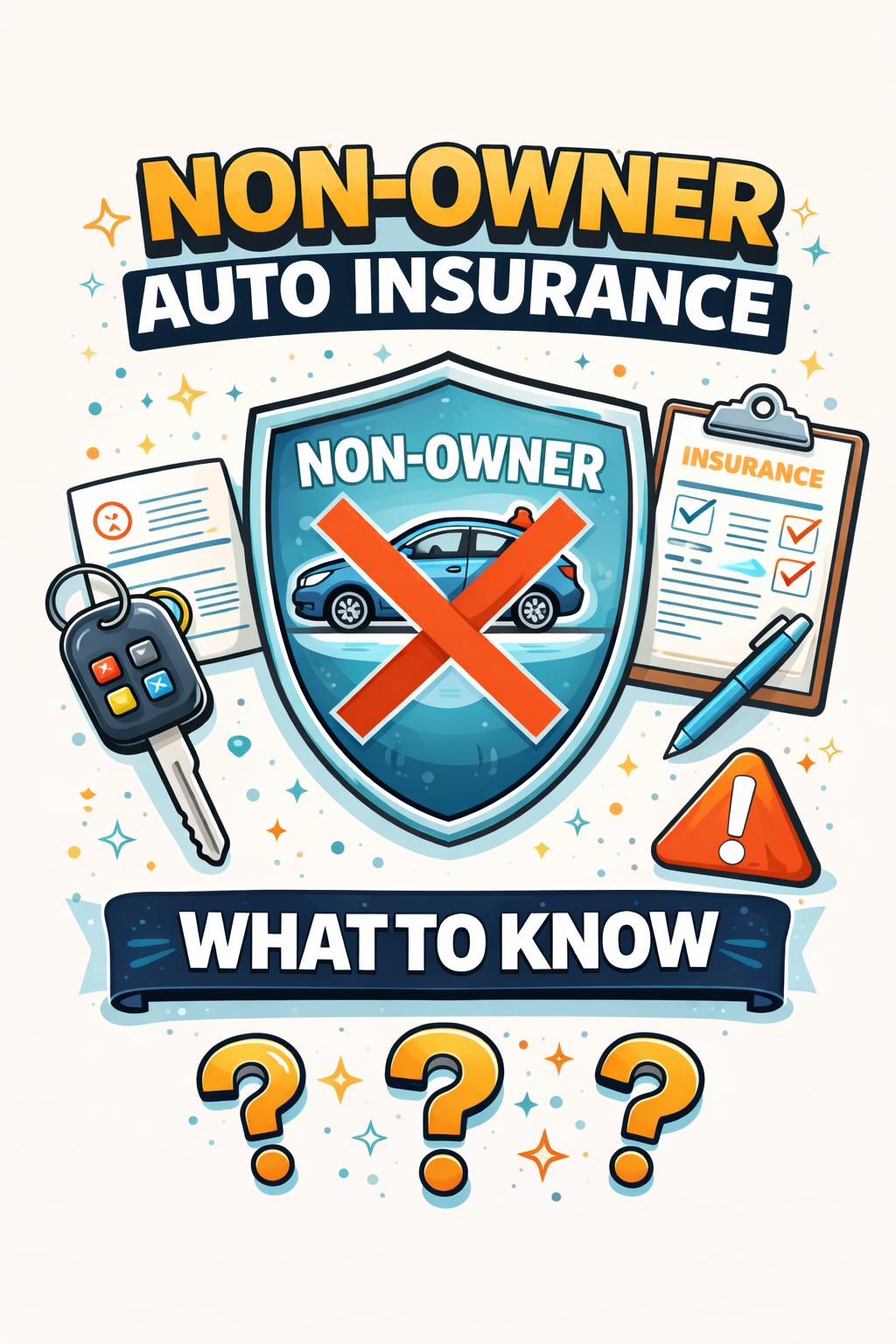
Quick answer: Non-owner car insurance sounds simple — but it’s not. If you live with someone who owns a car or have regular access to one, a non-owner policy may not work the way you think.
The Call I Get All the Time
A woman called me the other day and said:
“My husband doesn’t own the car. We just need a non-owner policy.”
Sounds simple.
But it almost never is.
Because the moment you look at how these policies are actually written — like this one from Bristol West Insurance Group — you realize something important:
A non-owner policy is not designed for people who have regular access to a car.
What the Policy Actually Says (And Why It Matters)
Here’s the real takeaway from the policy language. It covers vehicles you don’t own as long as long as your using that vehicle with permission. What It doesn’t cover is any vehicle owned by you, your spouse, or anyone in your household.
That last part is where most people run into trouble, because it eliminates the exact situation many people think a non-owner policy is for.
The Biggest Misunderstanding
Here’s how it plays out in real life. The husband doesn’t own a car. The wife owns the car. They live together. So they think: “Perfect — we’ll just get him a non-owner policy.”
But from the insurance company’s perspective, that’s not occasional use — that’s a household exposure. And non-owner policies simply aren’t built for that.
What “Regular Access” Actually Means
This is where people try to oversimplify things — and it’s where mistakes happen.
I hear this all the time: “Oh no, I don’t have permission to drive the car.” That sounds good.
But that’s not how insurance companies look at it.
Access Isn’t About What You Say — It’s About What’s Real. Carriers evaluate access based on reality, not statements. If a vehicle is parked at your home, sitting in your driveway, available where you live, the the assumption is straightforward: you have access to it.
If the car is sitting in the same driveway, you can get to it, you could drive it, and you’re considered part of the exposure — even if you insist “I never drive it” or “I’m not allowed to.” That alone doesn’t remove the risk.
Why isn’t “no permission” enough? Because permission is easy to say and impossible to control. Household members share vehicles. Emergencies happen. Convenience happens. So carriers don’t underwrite based on promises — they underwrite based on possibility.
What a Non-Owner Policy Is Actually For
A true non-owner policy is meant for someone who doesn’t own a vehicle, doesn’t live with someone who owns one, doesn’t have regular access to a car, and only drives occasionally.
That’s someone between vehicles, someone who rents cars now and then, or someone who needs an FR-44 filing but genuinely doesn’t own a car. That’s the clean use case.
Where This Goes Wrong (And I See This Every Day)
This comes up constantly with FR-44 situations.
Someone tells me, “I don’t have a car.” But in reality, they live with someone who does, the car is sitting in the driveway, and they can get to it anytime. Then they try to solve that with a non-owner policy — and that’s where things break.
When a policy is structured incorrectly, claims can be denied, policies can be canceled, and coverage gaps can show up at the worst possible moment. In an FR-44 situation, that can reset the entire compliance period.
If you’re not familiar with how strict that process is, here’s a good breakdown of how FR-44 insurance actually works in Florida. For a general overview of filing requirements, FR44.net is also a good reference.
You Can’t Solve a Household Problem With a Non-Owner Policy
The simplest way to put it: if the car is part of your household, it matters — whether you own it or not, and whether you drive it or not. If it’s in your driveway, your garage, or at your residence, the insurance company is going to treat that as access.
The Right Way to Handle It
There are better ways to structure this depending on the situation — being properly listed on the household policy, being excluded when the company allows it, setting up coverage intentionally from the start, or using a non-owner policy only when it genuinely fits. It just has to be done correctly.
I deal with this constantly, especially with FR-44 filings. People reach for what looks like the simplest option, and it ends up being the most expensive mistake — because auto insurance isn’t just about having a policy. It’s about having the right structure behind it.
If you want a deeper look at that idea, here’s a breakdown of why auto insurance is a process, not a one-time purchase.
The Bottom Line
A non-owner policy isn’t a shortcut. It’s a very specific tool, and when it’s used in the wrong situation, it doesn’t work the way people expect.
If you live in a household with a vehicle, that exposure needs to be handled correctly — and if you’re trying to figure out whether a non-owner policy actually fits your situation, or you’re working through an FR-44 filing, I’m glad to help you set it up the right way from the start.
About the Author
Written by Clifford Schimek — Florida Auto & FR-44 Insurance Expert
I help Florida drivers every day with auto insurance quotes and FR-44 filings. Non-owner policies get misunderstood a lot — especially by people who live with a car owner or have regular access to one — and I help drivers figure out whether it actually fits their situation. My goal is to make everything simpler and less stressful, no matter where you live in the state. If you ever need help or just want a straight answer, you can always call or text me directly.
Clifford Schimek — Florida Auto & FR-44 Insurance Expert
Call or text: 305-796-2968
Learn More About Cliff
Why Clifford Schimek? – The case for working with me
Florida Auto Plus Insurance – Agency website
Florida FR-44 Information and Guidance – For Florida drivers who need an FR-44 filing
View my Google Business Profile – Reviews and Business information