Quick answer Florida’s legal minimum coverage looks like the cheapest option, but skipping bodily injury liability often saves very little upfront — and can quietly cost more later through weaker future pricing and real financial exposure after an accident.
I get some version of this phone call almost every day.
“I just want the cheapest thing you’ve got.”
I understand the instinct completely. Nobody calls me excited to spend more money on insurance. But after enough years of running quotes side by side, I’ve learned something that surprises most drivers the first time I explain it:
In Florida, the “bare minimum” policy isn’t always the cheapest option. Sometimes it’s actually the more expensive one — just not in a way that shows up right away.
What Florida’s Minimum Coverage Actually Looks Like
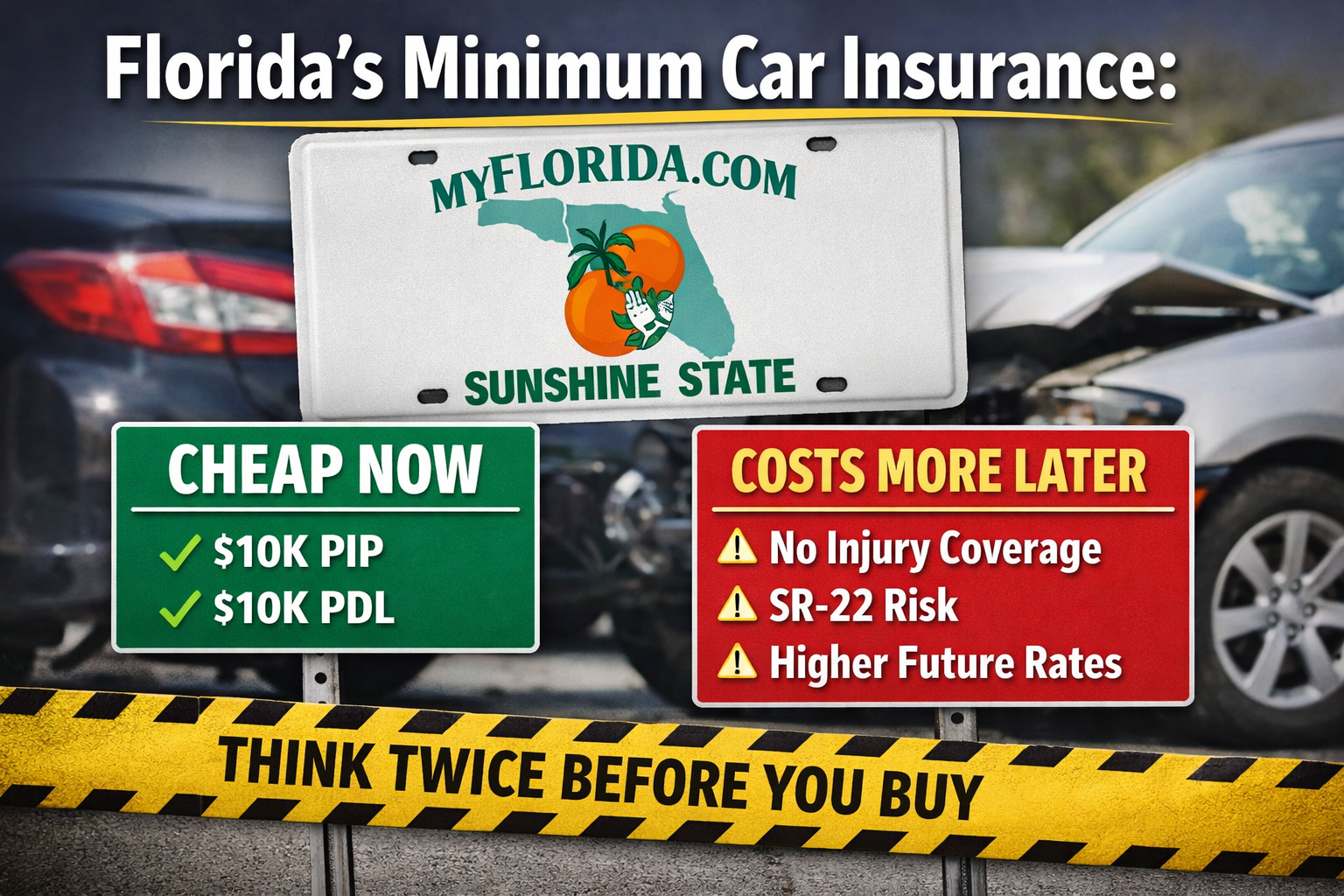
Florida’s legal minimum is $10,000 in Personal Injury Protection and $10,000 in Property Damage Liability. People usually call this PIP/PD only, and it really is the bare bones — just enough to legally register your car.
The minimum requirement is only the beginning. See Florida auto insurance coverage and claims explained to understand which losses the required coverages address—and which important exposures remain.
Notice what’s missing from that list. There’s no bodily injury liability at all. If you cause an accident and seriously hurt someone, that minimum policy does nothing to protect you financially.
That’s where Florida’s financial responsibility law quietly enters the picture. If you’re at fault in an accident involving injuries, the state expects you to be able to cover at least 10/20/10 — $10,000 per person, $20,000 per accident, $10,000 in property damage. Whether you technically carry that coverage or not, you can still be held responsible for it.
Drivers financing or protecting their own vehicle also need to understand what “full coverage” really includes beyond Florida’s minimum.
Why “Removing” Liability Doesn’t Save What People Expect
A lot of drivers assume that stripping out bodily injury liability is where the real savings are. So when I run their quote, that’s usually the first thing they ask me to take off.
Here’s the part that catches people off guard: when I actually run the numbers, removing it often saves very little. Sometimes a few dollars a month. Once in a while, I’ve seen quotes come back where adding the coverage barely moves the price at all.
That’s not a coincidence. Insurance companies aren’t just pricing the coverage itself — they’re pricing the kind of driver who carries it. Drivers who maintain liability coverage tend to be viewed as a steadier risk over time, and pricing tends to reflect that.
There’s another piece of this people don’t expect. Some companies don’t even sell a PIP/PD-only policy. Their minimum offering already includes bodily injury liability, and they price that combination competitively enough that they regularly beat out companies that only quote bare-bones coverage. So in some cases, it’s not just that adding liability costs “a little more” — the company that includes it from the start can actually come in lower than the one trying to sell you the stripped-down version. That’s exactly why running an actual side-by-side comparison matters more than assuming the bare minimum will always be the lowest number.
I’ll tell you where I personally land on this, because it shapes every quote I run. I refuse to write PIP/PD-only policies for my clients. Not because of a rule somewhere — because of what I’ve watched it do to people, today and down the road. That stripped-down version puts a policyholder in a worse position on both sides of the equation, coverage and premium, and there’s rarely a good reason for it once you actually run the comparison. The lowest coverage I’ll put someone in is whatever satisfies Florida’s financial responsibility law — that 10/20/10 I mentioned earlier. To me, that’s the real floor, not the legal minimum on paper. I won’t put a client in a position I know isn’t good for them, even if it’s technically legal to do so.
The Part That Shows Up Later, Not Right Away
This is the piece I really want people to understand, because it’s the one nobody explains upfront.
Carrying bodily injury liability builds something you can’t see on your declarations page: a prior liability insurance history. And that history follows you into every future quote you ever get.
Drivers who’ve never carried it often find that fewer companies want to compete for their business down the road, and the pricing tiers they qualify for aren’t as strong. I touched on this same idea in my piece on Florida auto insurance liability and how much is enough — the limits you carry today quietly shape the options you’ll have years from now.
So the “savings” from skipping liability coverage can end up costing more later, just in a way that’s harder to connect back to the original decision.
That widespread lack of bodily injury coverage is one reason uninsured motorist protection deserves a deliberate decision.
What Happens If You’re Driving on Minimum and Something Goes Wrong
If you’re carrying PIP/PD only and you cause an accident with injuries, a few things can happen at once. You can be held personally responsible for the difference. Your license can be affected. And depending on how things unfold, you may end up needing an SR-22 to keep driving legally.
Once that happens, the cost of “going minimum” stops being theoretical. Premiums go up, your options shrink, and the situation tends to follow you for years rather than months.
I see a very similar pattern with FR-44 cases, just starting from a different place. A short-term decision — skipping coverage, missing a renewal, assuming it’ll be fine — turns into years of higher required limits and strict compliance rules. I’ve written about that dynamic in more detail in FR-44 insurance isn’t a policy, it’s an ongoing compliance requirement, because the underlying lesson is the same: what looks like a small decision today rarely stays small.
A Real Example I Ran Recently
A new client called me a few weeks ago wanting the cheapest possible policy. Clean record, no tickets, no accidents — just budget-conscious, which is completely reasonable.
When I ran his quote with PIP/PD only versus adding basic 10/20/10 liability, the difference came out to less than four dollars a month. He was stunned. He’d assumed liability coverage would roughly double his bill.
He added it. Not because I talked him into it, but because once he saw the actual numbers, the decision made itself.
That’s usually how these conversations go once people see the real comparison instead of guessing at it.
The Bottom Line
The cheapest-looking policy on paper isn’t always the cheapest one in practice. Sometimes the gap between minimum coverage and basic liability protection is so small that skipping it doesn’t save much of anything — and it can quietly cost you more down the road, both in protection and in future pricing.
This is really just another example of something I talk about constantly: auto insurance isn’t a one-time purchase, it’s a process. The decisions you make today shape the options you have later, whether you can see that connection right away or not.
Every driver’s situation is different. Some people genuinely are fine starting at the lowest point. Others have a little more room than they realize to get better protection without spending much more. The only way to know which one you are is to actually run the numbers side by side — not guess.
If you’d like me to take a look at your situation and show you the real comparison, I’m easy to reach.
Related Florida Auto Insurance Guides
Whether you’re buying a new policy, comparing quotes, understanding Florida insurance laws, or looking for ways to lower your premium, these in-depth guides will help you make more informed insurance decisions.
• Florida Auto Insurance – Start with our complete guide to buying, comparing, and understanding Florida auto insurance from the ground up.
• Florida Auto Insurance Coverage and Claims – Learn how liability, collision, comprehensive, uninsured motorist coverage, and the claims process work before you ever need them.
• Florida Auto Insurance Laws and Requirements – Understand Florida’s insurance laws, minimum coverage requirements, FR-44 and SR-22 filings, and the legal responsibilities every Florida driver should know.
• Safe Driving & Saving Money – Discover the many factors that influence your premium, practical ways to reduce your insurance costs, and how smart driving habits can help you save over time.
• Florida FR-44 Insurance – Everything Florida drivers need to know about FR-44 insurance after a DUI, including filing requirements, reinstatement, non-owner policies, and affordable coverage options.
Continue Reading About Florida Auto Insurance Coverage & Claims
If you found this guide helpful, these articles explore Florida auto insurance coverage, claims, and settlement issues in greater detail:
Florida Auto Insurance Coverage & Claims: What Your Policy Actually Does — And What Happens When You File a Claim (This article) – Start with our complete guide to understanding what your Florida auto insurance policy covers, how claims work, and how to make smarter coverage decisions.
How Much Liability Insurance Do I Really Need in Florida? – State minimum limits may satisfy Florida law, but they may not adequately protect your income, savings, or future. Learn how to choose liability limits that fit your personal financial situation.
What Is Full Coverage Car Insurance in Florida? – Many people ask for “full coverage,” but the term has no legal or insurance definition. Find out what it usually includes and how to decide whether it’s appropriate for your vehicle.
Uninsured Motorist Coverage in Florida – What happens if the driver who hits you has little or no insurance? Learn why uninsured motorist coverage is one of the most valuable protections many Florida drivers can buy.
Florida Minimum Car Insurance Isn’t Always the Bargain It Looks Like (This article)– Florida’s legal minimum looks cheap upfront, but can cost more later in pricing and real exposure.
Do You Really Have to Call Your Insurance Company After a Minor Accident? – Not every accident automatically requires an insurance claim. Learn when reporting an accident makes sense, what happens after you report it, and how your decision can affect future premiums.
That Total Loss Number Doesn’t Look Right – Receiving a total loss settlement can be frustrating if the value seems too low. Learn how insurance companies determine actual cash value and what you can do if you disagree with the offer.
C.L.U.E. Reports: The Hidden Claim Record – Most drivers never realize that claims can continue affecting their insurance long after an accident is over. Learn what a C.L.U.E. report is, what information it contains, and why reviewing it can help you avoid surprises.
About the Author
Written by Clifford Schimek — Florida Auto & FR-44 Insurance Expert
I help Florida drivers every day with auto insurance quotes and FR-44 filings. Skipping bodily injury liability might look like savings on paper, but it’s one of the most common ways drivers end up exposed later — both financially and on future pricing. My goal is to make everything simpler and less stressful, no matter where you live in the state. If you ever need help or just want a straight answer, you can always call or text me directly.
Clifford Schimek — Florida Auto & FR-44 Insurance Expert
Call or text: 305-796-2968
Learn More About Cliff
Why Clifford Schimek? – The case for working with me
Florida Auto Plus Insurance – Agency website
Florida FR-44 Information and Guidance – For Florida drivers who need an FR-44 filing
View my Google Business Profile – Reviews and business information