
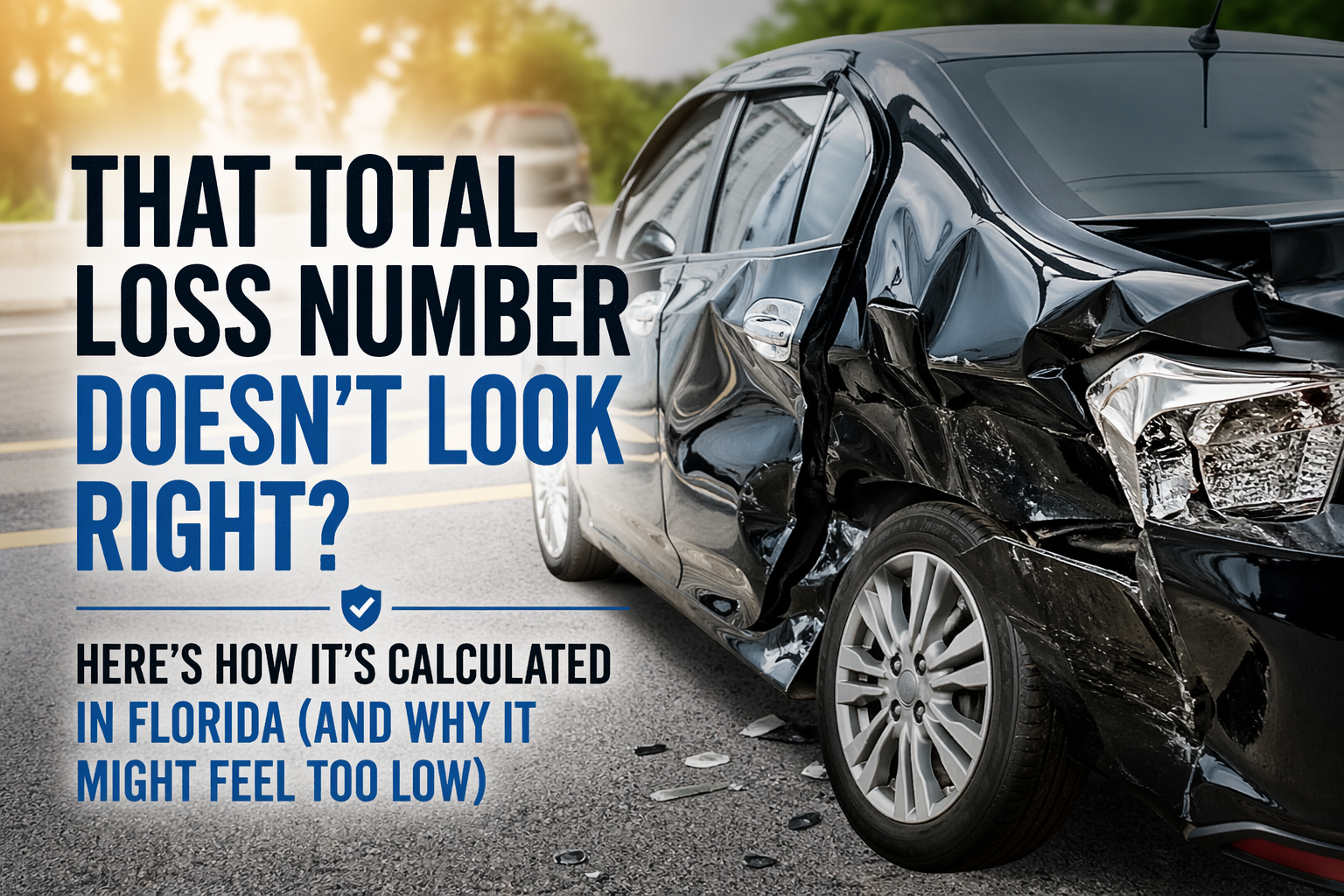
Quick answer: If your car is totaled in Florida, the insurance company pays what it was worth in the real market just before the accident — not what you paid or what you owe. The process is structured, but small details in how that value is calculated can make a bigger difference than most people expect.
“That number doesn’t seem right.”
I hear that all the time.
And to be fair, sometimes it isn’t.
If you’ve just been told your car is a total loss, what you’re looking at is not a random number — but it’s also not always a perfect one either. So let’s walk through how insurance companies actually calculate that number in Florida, and where things can go off track.
What “Total Loss” Really Means
A vehicle becomes a total loss when the cost to repair it gets close to, or exceeds, what the car is worth. At that point, the insurance company doesn’t fix it — they pay you for the value of the vehicle right before the accident.
That value is called Actual Cash Value, or ACV.
And this is where most of the confusion starts.
What Actual Cash Value Really Is
ACV is simply what your car was worth in the real market immediately before the loss.
Not what you paid for it.
Not what you still owe.
Not what a dealership is asking for one today.
It’s what a similar vehicle would have realistically sold for, right before the accident happened.
That distinction matters more than people expect.
A total-loss settlement is only one part of the larger claims process. Our Florida auto insurance coverage and claims guide explains how limits, deductibles, and the applicable coverage control what a policy can pay.
How Insurance Companies Come Up With the Number
In Florida, insurance companies are required to use a market-based valuation method. In plain terms, they’re supposed to look at what comparable vehicles are actually selling for.
Most carriers rely on third-party valuation systems that pull recent sales data — same or similar year, make, model, mileage range, and general area.
Then they adjust from there.
And that’s where I see things start to drift.
Where I See Problems All the Time
On paper, the process is straightforward. In reality, small details can move that number more than you’d think.
I regularly see reports where the trim level is wrong, options are missing, or the mileage is off. Sometimes the comparable vehicles aren’t truly comparable, or they’re pulled from a different type of market.
Individually, those sound minor. But stack a few of them together, and now you’re looking at a number that’s off by hundreds — sometimes thousands — of dollars.
That’s why I always tell people: don’t just look at the number. Look at how they got there.
What Should Be Included in the Settlement
A proper total loss settlement in Florida isn’t just the base value of the vehicle. It should also include applicable sales tax and certain title or registration-related costs, depending on the situation.
The goal is to put you in a position to replace the vehicle — not just hand you a stripped-down number.
This is also where I see people make a decision that sounds logical on the surface, but isn’t always thought through all the way. A lot of drivers look at the value of their vehicle and say, “It’s only worth this much, so it’s probably not worth carrying collision anymore.” And yes, in general, as the value of the car goes down, the cost of collision coverage usually comes down with it. But that’s not the only factor. The cost of that coverage is also influenced by things like your driving history, your deductible, and how the vehicle is rated overall — not just what it would pay in a total loss. And this is exactly where the idea of “full coverage” tends to get misunderstood. It’s not a real coverage you can select — it’s just a phrase people use, and it often leads to decisions being made without really understanding what’s included and what’s being given up. I break that down in more detail here: What “Full Coverage” Really Means — and What It Doesn’t
What the Settlement Does Not Consider
This is where people get surprised.
The insurance company is not factoring in your loan balance. They’re not looking at what you paid for the car, or what a dealer is asking today.
They’re focused strictly on market value at the time of loss.
That’s exactly why policy structure matters ahead of time. Situations like this are where something like gap coverage becomes relevant — and where the way your policy was set up starts to show up in real life.
It ties directly into something I talk about all the time — that auto insurance isn’t a one-time purchase, it’s an ongoing process. If you want a deeper look at that idea, this breaks it down further:
https://floridaautoplusinsurance.com/auto-insurance-isnt-just-a-policy-its-a-process/
And if you’re dealing with a situation where filings or compliance are part of the bigger picture, especially after something like a DUI, this also connects to how policies are structured and maintained over time:
https://fr44.net/
You’re Entitled to the Full Report
One of the biggest misconceptions I see is that the number you’re given is final.
It’s not.
You have every right to request the full valuation report, see the comparable vehicles they used, and review every adjustment that was made.
And you should.
Because this is where corrections happen.
What to Do If the Number Feels Off
If something doesn’t look right, slow the process down.
Ask for the report. Go through it line by line. If needed, find your own comparable vehicles and point out specific differences.
Most of the time, when you present a clear, fact-based challenge, the insurance company will take another look and make adjustments where appropriate.
If it doesn’t get resolved, you can also reach out to the Florida Department of Financial Services for guidance.
The Bigger Picture
This is one of those moments where everything about how your policy was set up starts to matter.
Not just the coverages you chose, but how the policy was structured, how it was written, and how it’s been maintained.
That’s why I say this all the time — and situations like this are exactly what I’m talking about:
Auto insurance isn’t just a policy. It’s a process.
The Bottom Line
Florida requires insurance companies to use a market-based valuation, support the number with real data, and include applicable taxes and fees.
But that doesn’t mean the first number you see is always right.
And before a valuation can occur, the driver first has to decide whether to report the accident and open a claim.
What I Tell My Clients
When you’re dealing with a total loss, don’t rush it.
Get the report.
Review the details.
Ask questions.
Because once you accept the settlement, the process is over.
And this is one of those situations where a little attention can make a real financial difference.
After the settlement, the loss may also appear in your C.L.U.E. claims history and influence future insurance quotes.
Related Florida Auto Insurance Guides
Whether you’re buying a new policy, comparing quotes, understanding Florida insurance laws, or looking for ways to lower your premium, these in-depth guides will help you make more informed insurance decisions.
• Florida Auto Insurance – Start with our complete guide to buying, comparing, and understanding Florida auto insurance from the ground up.
• Florida Auto Insurance Coverage and Claims – Learn how liability, collision, comprehensive, uninsured motorist coverage, and the claims process work before you ever need them.
• Florida Auto Insurance Laws and Requirements – Understand Florida’s insurance laws, minimum coverage requirements, FR-44 and SR-22 filings, and the legal responsibilities every Florida driver should know.
• Safe Driving & Saving Money – Discover the many factors that influence your premium, practical ways to reduce your insurance costs, and how smart driving habits can help you save over time.
• Florida FR-44 Insurance – Everything Florida drivers need to know about FR-44 insurance after a DUI, including filing requirements, reinstatement, non-owner policies, and affordable coverage options.
Continue Reading About Florida Auto Insurance Coverage & Claims
If you found this guide helpful, these articles explore Florida auto insurance coverage, claims, and settlement issues in greater detail:
Florida Auto Insurance Coverage & Claims: What Your Policy Actually Does — And What Happens When You File a Claim (This article) – Start with our complete guide to understanding what your Florida auto insurance policy covers, how claims work, and how to make smarter coverage decisions.
How Much Liability Insurance Do I Really Need in Florida? – State minimum limits may satisfy Florida law, but they may not adequately protect your income, savings, or future. Learn how to choose liability limits that fit your personal financial situation.
What Is Full Coverage Car Insurance in Florida? – Many people ask for “full coverage,” but the term has no legal or insurance definition. Find out what it usually includes and how to decide whether it’s appropriate for your vehicle.
Uninsured Motorist Coverage in Florida – What happens if the driver who hits you has little or no insurance? Learn why uninsured motorist coverage is one of the most valuable protections many Florida drivers can buy.
Florida Minimum Car Insurance Isn’t Always the Bargain It Looks Like – Florida’s legal minimum looks cheap upfront, but can cost more later in pricing and real exposure.
Do You Really Have to Call Your Insurance Company After a Minor Accident? – Not every accident automatically requires an insurance claim. Learn when reporting an accident makes sense, what happens after you report it, and how your decision can affect future premiums.
That Total Loss Number Doesn’t Look Right (This article) – Receiving a total loss settlement can be frustrating if the value seems too low. Learn how insurance companies determine actual cash value and what you can do if you disagree with the offer.
C.L.U.E. Reports: The Hidden Claim Record – Most drivers never realize that claims can continue affecting their insurance long after an accident is over. Learn what a C.L.U.E. report is, what information it contains, and why reviewing it can help you avoid surprises.
About the Author
Written by Clifford Schimek — Florida Auto & FR-44 Insurance Expert
I help Florida drivers every day with auto insurance quotes and FR-44 filings. My goal is to make everything simpler and less stressful, no matter where you live in the state. Total loss claims are one of the situations I walk clients through most often, especially when it comes to making sure they actually understand the valuation and know what they’re entitled to before signing anything. If you ever need help or just want a straight answer, you can always call or text me directly.
Clifford Schimek — Florida Auto & FR-44 Insurance Expert
Call or text 305-796-2968
Learn More About Cliff
Why Clifford Schimek? – The case for working with me
Florida Auto Plus Insurance – Agency website
Florida FR-44 Information and Guidance – For Florida drivers who need an FR-44 filing
View my Google Business Profile – Reviews and business information