Quick answer: Uninsured motorist coverage doesn’t repair your car — it protects you and your family when the other driver doesn’t carry enough insurance to cover what they owe you. In Florida, where many drivers carry little or no bodily injury liability, how that coverage is structured — stacked versus unstacked — can be the difference between a fraction of your damages and the full amount.
If you’ve ever looked at your policy and wondered whether uninsured motorist coverage is really worth it, you’re not alone. It’s one of the most misunderstood pieces of a Florida auto policy, and I talk about it with clients almost every week. The same questions come up over and over: Why does it cost so much? When does it actually apply? And does it cover my car if someone hits me?
Uninsured motorist coverage makes more sense when viewed beside the rest of the policy. Our Florida auto insurance coverage and claims overview shows where UM fits with PIP, liability, collision, and comprehensive.
Let me walk through it the same way I do when I’m sitting across from a client.
What Uninsured Motorist Coverage Actually Does
Uninsured motorist coverage — UM, for short — pays you when the other driver caused the accident but doesn’t have enough bodily injury liability coverage to pay for what you’re owed. Sometimes they have none at all. Either way, UM can help cover your medical bills, lost wages, and other damages you’re legally entitled to recover.
Here’s the part that surprises people: in Florida, bodily injury liability coverage isn’t required for most drivers. That means the person who hits you might be carrying no liability coverage whatsoever, or limits so low they wouldn’t begin to cover a serious injury. UM exists specifically to fill that gap.
What UM Doesn’t Cover
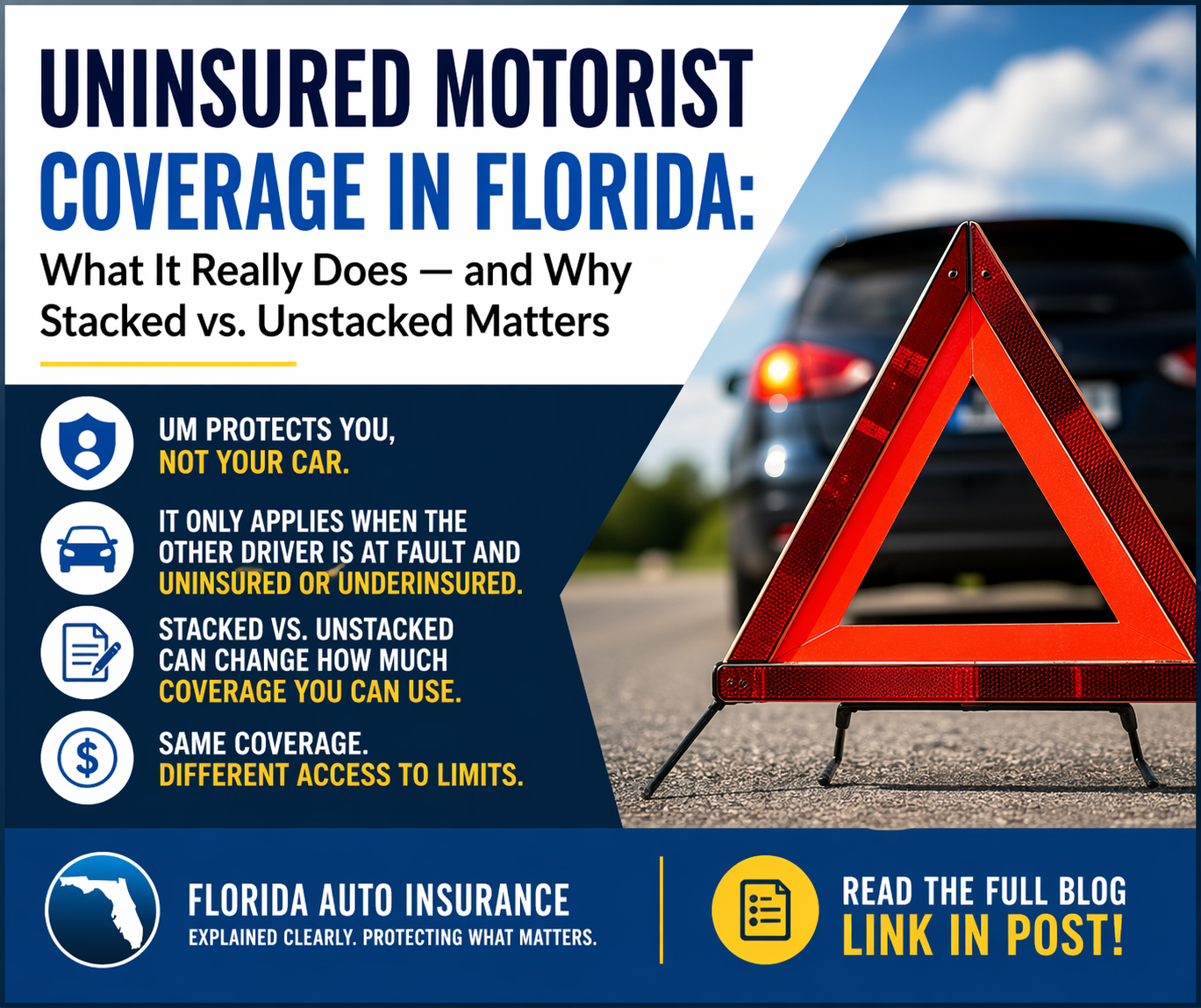
This is where people get caught off guard. UM does not pay for damage to your vehicle. It doesn’t matter if the other driver has no insurance, is clearly at fault, or your car is sitting in the driveway with the front end caved in — UM was never designed to fix your car.
Your vehicle is protected by two other coverages instead:
- Collision coverage, for accidents
- Comprehensive coverage, for theft, weather, and other non-collision damage
Those apply regardless of who caused the accident, including situations where the other driver has no insurance at all.
So think of it as two completely separate buckets. UM protects you. Comp and collision protect your car.
The Trigger for UM Is Specific
UM doesn’t kick in just because something bad happened on the road. It generally applies when the other driver is at fault and doesn’t carry enough bodily injury coverage to pay for your damages. If you caused the accident, UM doesn’t come into play. If fault is unclear, things can get complicated. And if there’s no uninsured or underinsured driver involved in the first place, UM may never be relevant to your claim at all.
Compare that to PIP, which works differently. Florida is a no-fault state, so your PIP pays regardless of who caused the accident — but it’s limited, usually to $10,000, and that gets used up fast in anything beyond a minor injury.
Florida’s minimum insurance structure helps explain why a responsible driver may still be injured by someone with no bodily injury liability coverage.
Why So Many Florida Drivers Have a Gap
A lot of people assume the other driver on the road must be carrying decent coverage. That’s not always true. In Florida, plenty of drivers carry no bodily injury liability at all, and many more carry the bare minimum. So when something serious happens, there’s often a real gap between what you’re owed and what the at-fault driver can actually pay. UM exists because that gap is real, and it shows up more often in Florida than most drivers expect.
I’ve written before about how much liability coverage is actually enough for a Florida driver, and the honest answer is that the minimum required by the state rarely matches what most people would want if they understood what it leaves exposed. That same gap is exactly what makes UM so important on your own policy — it’s protecting you from the very thing so many other drivers are underinsured for.
It’s also worth understanding if you’re already dealing with higher liability requirements, such as an FR-44 filing after a DUI — those situations make proper limits even more important.
Why UM Costs What It Costs
People see the premium for UM and hesitate. I understand why. But here’s the reasoning behind the cost: this is one of the few coverages that can pay a large bodily injury claim directly to you. You’re essentially insuring yourself against the other driver’s lack of coverage. When it applies, it’s rarely a small claim — it’s often a significant one, which is exactly why the premium reflects that.
UM Isn’t Just Yes or No
This is where I slow people down, because it’s one of the more important decisions on the entire policy, and it’s not as simple as accepting or rejecting UM outright.
In Florida, the default offer is typically the broadest version available — stacked UM at limits equal to your bodily injury liability. Choosing anything different requires a signed form. That includes rejecting UM entirely, choosing lower limits, or selecting unstacked coverage instead of stacked.
Before you sign that form, it’s worth taking a moment to understand exactly what you’re agreeing to. That piece of paper is where people unknowingly reduce their coverage or give it up altogether — sometimes without realizing the impact until much later. It isn’t paperwork to sign without reading.
The good news is that UM is genuinely flexible. You can take full UM at stacked limits equal to your liability coverage for the broadest protection, choose lower limits to bring the cost down, choose stacked or unstacked, or reject it entirely. Lower limits mean a lower premium. Higher limits mean more protection if you ever need it. It’s a real decision, not a formality.
Stacked vs. Unstacked: Same Coverage, Different Access
This is where the structure really starts to matter. The coverage itself is identical — same trigger, same type of protection either way. What changes is how much of it you’re actually able to use.
With stacked UM, each vehicle on your policy carries its own limit, and those limits can be combined. If you have three vehicles, each carrying $100,000 in UM, stacking means you potentially have up to $300,000 available.
With unstacked UM, only one limit applies, no matter how many vehicles you have. Those same three vehicles, each with $100,000 in UM, would leave you with just $100,000 available.
Picture a serious accident where the other driver has no insurance and your damages come to $250,000. With unstacked coverage, you’d have $100,000 available. With stacked coverage, depending on your policy, you could have $200,000 to $300,000 or more. That’s not a theoretical difference — it’s the kind of gap that changes someone’s financial recovery after a bad accident.
How I Talk Clients Through This
I don’t push UM on everyone, because every situation is different. But I do ask one question that tends to put things in perspective: if someone with no insurance seriously injures you or a family member, how much protection do you actually want standing behind you? In Florida, that situation happens more often than people think, and it’s worth answering that question honestly before you sign anything.
This is really just one more example of something I tell clients constantly — auto insurance isn’t a one-time decision, it’s an ongoing process, and UM is one of the clearest places where that shows up. The right choice today shapes how protected you and your family actually are if the worst happens down the road.
The Bottom Line
UM protects you, not your vehicle, and it only applies when the at-fault driver doesn’t carry enough bodily injury coverage. In Florida, where so many drivers carry little or none, that gap is real and worth taking seriously.
The “full coverage” misconception becomes especially dangerous when a driver assumes collision and comprehensive also provide uninsured motorist protection.
Stacked versus unstacked doesn’t change what the coverage does — it changes how much of it you can actually access when you need it most. That’s exactly why this is one of the decisions on your policy that deserves a real conversation, not a quick signature.
If you’d like to go through your own UM limits and figure out what makes sense for your situation, I’m happy to walk through it with you.
Related Florida Auto Insurance Guides
Whether you’re buying a new policy, comparing quotes, understanding Florida insurance laws, or looking for ways to lower your premium, these in-depth guides will help you make more informed insurance decisions.
• Florida Auto Insurance – Start with our complete guide to buying, comparing, and understanding Florida auto insurance from the ground up.
• Florida Auto Insurance Coverage and Claims – Learn how liability, collision, comprehensive, uninsured motorist coverage, and the claims process work before you ever need them.
• Florida Auto Insurance Laws and Requirements – Understand Florida’s insurance laws, minimum coverage requirements, FR-44 and SR-22 filings, and the legal responsibilities every Florida driver should know.
• Safe Driving & Saving Money – Discover the many factors that influence your premium, practical ways to reduce your insurance costs, and how smart driving habits can help you save over time.
• Florida FR-44 Insurance – Everything Florida drivers need to know about FR-44 insurance after a DUI, including filing requirements, reinstatement, non-owner policies, and affordable coverage options.
Continue Reading About Florida Auto Insurance Coverage & Claims
If you found this guide helpful, these articles explore Florida auto insurance coverage, claims, and settlement issues in greater detail:
Florida Auto Insurance Coverage & Claims: What Your Policy Actually Does — And What Happens When You File a Claim – Start with our complete guide to understanding what your Florida auto insurance policy covers, how claims work, and how to make smarter coverage decisions.
How Much Liability Insurance Do I Really Need in Florida? – State minimum limits may satisfy Florida law, but they may not adequately protect your income, savings, or future. Learn how to choose liability limits that fit your personal financial situation.
What Is Full Coverage Car Insurance in Florida? – Many people ask for “full coverage,” but the term has no legal or insurance definition. Find out what it usually includes and how to decide whether it’s appropriate for your vehicle.
Uninsured Motorist Coverage in Florida (This article) – What happens if the driver who hits you has little or no insurance? Learn why uninsured motorist coverage is one of the most valuable protections many Florida drivers can buy.
Florida Minimum Car Insurance Isn’t Always the Bargain It Looks Like – Florida’s legal minimum looks cheap upfront, but can cost more later in pricing and real exposure.
Do You Really Have to Call Your Insurance Company After a Minor Accident? – Not every accident automatically requires an insurance claim. Learn when reporting an accident makes sense, what happens after you report it, and how your decision can affect future premiums.
That Total Loss Number Doesn’t Look Right – Receiving a total loss settlement can be frustrating if the value seems too low. Learn how insurance companies determine actual cash value and what you can do if you disagree with the offer.
C.L.U.E. Reports: The Hidden Claim Record – Most drivers never realize that claims can continue affecting their insurance long after an accident is over. Learn what a C.L.U.E. report is, what information it contains, and why reviewing it can help you avoid surprises.
About the Author
Written by Clifford Schimek — Florida Auto & FR-44 Insurance Expert
I help Florida drivers every day with auto insurance quotes and FR-44 filings, and understand how their coverage actually works, not just what it costs. Uninsured motorist coverage is one of the pieces people understand least, but it can matter more than almost any other line on the policy. My goal is to make everything simpler and less stressful, no matter where you live in the state. If you ever need help or just want a straight answer, you can call or text me directly
Clifford Schimek — Florida Auto & FR-44 Insurance Expert
Call or text: 305-796-2968