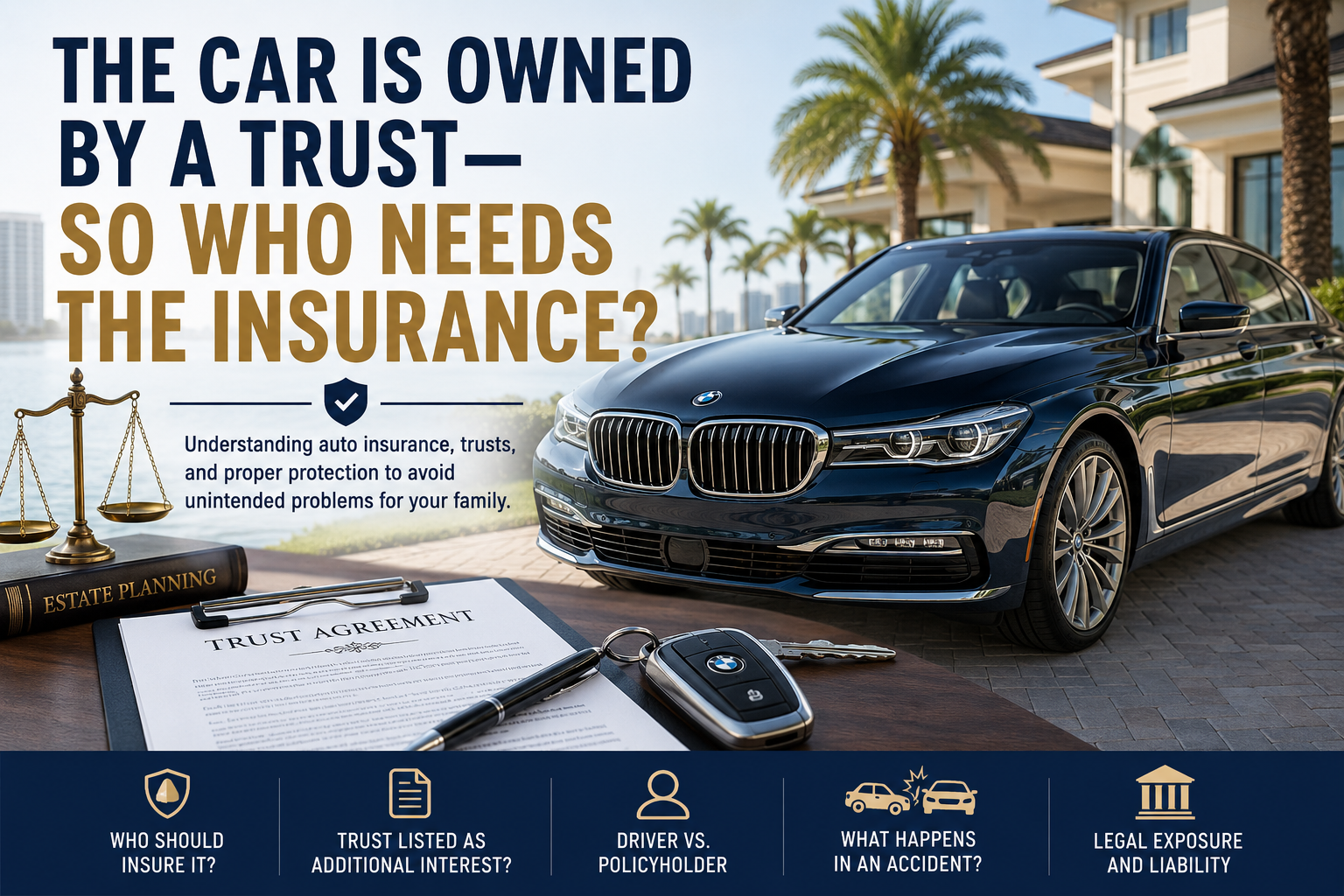
Quick Answer: When a car is titled to a trust, estate, or business entity, insurance companies typically insure the person with regular care, custody, and control of the vehicle — not just the name on the title. In most cases, the actual driver becomes the named insured, while the trust can often be listed as an additional interest, as long as the ownership structure is fully disclosed to the insurer.
One of the most misunderstood situations in Florida auto insurance is when a vehicle is titled to a trust, estate, or business entity — but driven and insured by someone else. Just yesterday, I found myself in the middle of a real-world conversation involving an attorney, a trust-owned BMW 760i, and questions that most people never think about until the situation is already unfolding. The discussion highlighted how insurance companies evaluate exposure, how trusts can sometimes be listed on policies, and why the cleanest insurance solution is not always the fastest one. Trust ownership is only one part of the compliance picture. This guide to Florida auto insurance laws and requirements explains how state law, policy duties, underwriting rules, and lender requirements fit together.
I run into unusual insurance situations all the time. This particular situation involved a trust-owned luxury vehicle, estate considerations, underwriting questions, and a beneficiary trying to handle everything properly without creating unintended problems for the family.
Just yesterday, I spent time speaking both with David, the attorney involved in the matter, and Michael, the individual who would ultimately become the primary driver and owner of the BMW 760i currently titled to the trust.
Naturally, several smart questions came up almost immediately:
- Who should actually insure the vehicle?
- Can the trust remain protected?
- Does the driver need to be the named insured?
- Can the trust simply be listed as an additional interest?
- What happens if there’s a serious accident?
- Does insurance completely eliminate potential legal exposure for the trust itself?
These are not theoretical questions.
They’re real-world issues that come up more often than people realize — especially with inherited vehicles, trusts, estates, family arrangements, and high-value automobiles.
How Insurance Companies Usually View the Exposure
One of the biggest misunderstandings people have is assuming the insurance company only cares about the name appearing on the vehicle title.
That’s not usually how underwriting works in practice.
In many situations, the insurance company is primarily focused on the person who has the regular care, custody, and control of the vehicle — meaning the person who is actually driving it, garaging it, maintaining it, and creating the daily exposure.
That’s why leased vehicles work the way they do. The leasing company technically owns the vehicle, but the lessee becomes the named insured because they’re the person operating the vehicle every day.
I’ve written before about situations involving The Driver, Not the Policyholder because the person using the vehicle and the titled owner are not always the same individual. That distinction becomes especially important in situations involving trusts, estates, inherited assets, and compliance-based insurance situations like FR-44 filings.
This situation also overlaps with another issue I see constantly in Florida households — how one driver’s exposure can impact an entire policy structure. I discussed that more deeply in Why Does Everyone’s Insurance Have to Go Up?.
In this particular situation, Progressive indicated they were generally comfortable with Michael being listed as the named insured and primary operator while separately listing the trust as an additional interest, provided the ownership structure was fully disclosed.
That last part matters enormously.
A related issue arises when an individual—not a trust—owns the vehicle but someone else handles the insurance, so it helps to understand whether the insurance must match the vehicle title.
Why Full Disclosure Matters
Whenever ownership structures become layered — trusts, estates, LLCs, inherited property, family-owned vehicles — problems can start when people try to “simplify” things by leaving details out.
That’s dangerous.
Insurance companies need to understand:
- who owns the vehicle,
- who primarily operates it,
- where it’s garaged,
- who has regular access to it,
- and what the actual exposure looks like.
If those facts are not properly disclosed, you can create underwriting problems, claim complications, or even allegations of material misrepresentation later.
That’s why situations like this should never be rushed or guessed through casually online.
The Most Important Part of Yesterday’s Conversation
Honestly, the most important part of yesterday’s discussion was realizing that just because a temporary insurance structure might be workable does not necessarily mean it’s the best long-term solution.
After carefully discussing the situation with both David and Michael, the cleanest overall approach became clear:
Wait for the death certificate process to finalize, transfer the vehicle properly into Michael’s individual name, and then allow Michael to purchase the insurance policy directly himself as both the titled owner and named insured.
From a structural standpoint, that creates the cleanest alignment between:
- ownership,
- underwriting,
- insurance,
- liability exposure,
- and future claims handling.
And sometimes the cleanest structure is also the safest structure.
Insurance Protection Does Not Eliminate Every Legal Risk
One of the attorney’s concerns was especially thoughtful — and honestly, very sophisticated.
Even with strong liability limits in place, could a catastrophic accident still potentially expose the trust or estate itself to litigation?
The honest answer is:
Potentially, yes.
Insurance is designed to provide defense and indemnity protection up to the policy limits. But insurance is not the same thing as eliminating all possible legal exposure in every catastrophic scenario.
That distinction matters.
People sometimes assume that once insurance exists, every possible problem automatically disappears. Real life is more complicated than that — especially when trusts, estates, inherited assets, and high-value vehicles are involved.
That’s why proper ownership structure, proper underwriting disclosure, and clean policy alignment matter so much from the beginning.
Auto Insurance Isn’t Just About Price
Situations like this are exactly why I often say that “Auto Insurance Isn’t Just a Policy — It’s a Process”.
Sometimes the structure itself becomes the most important part of the entire conversation.
Over the years, I’ve seen situations involving:
- inherited vehicles,
- elderly parents,
- estate transitions,
- trust-owned luxury vehicles,
- business-owned automobiles,
- adult children driving family-owned cars,
- and complex household arrangements.
Every situation is slightly different.
That’s why careful setup matters so much.
Unusual ownership arrangements are one reason working with a Florida auto insurance specialist can be different from entering limited information into an automated quote.
Related Florida Auto Insurance Guides
Whether you’re buying a new policy, comparing quotes, understanding Florida insurance laws, or looking for ways to lower your premium, these in-depth guides will help you make more informed insurance decisions.
• Florida Auto Insurance – Start with our complete guide to buying, comparing, and understanding Florida auto insurance from the ground up.
• Florida Auto Insurance Coverage and Claims – Learn how liability, collision, comprehensive, uninsured motorist coverage, and the claims process work before you ever need them.
• Florida Auto Insurance Laws and Requirements – Understand Florida’s insurance laws, minimum coverage requirements, FR-44 and SR-22 filings, and the legal responsibilities every Florida driver should know.
• Safe Driving & Saving Money – Discover the many factors that influence your premium, practical ways to reduce your insurance costs, and how smart driving habits can help you save over time.
• Florida FR-44 Insurance – Everything Florida drivers need to know about FR-44 insurance after a DUI, including filing requirements, reinstatement, non-owner policies, and affordable coverage options.
Continue Learning About Florida Auto Insurance Laws
Florida’s insurance laws can be confusing, especially when different situations require different rules. The articles below explain many of the legal questions Florida drivers ask most often and provide more detailed guidance on each topic.
Florida Auto Insurance Laws and Requirements: What Drivers Actually Need to Know
Florida auto insurance rules don’t come from one place. They come from state law, your policy contract, your carrier’s underwriting rules, and sometimes your lender
The Car Is in My Name—Doesn’t the Insurance Have to Be Too?
Vehicle ownership and insurance don’t always have to match exactly. This article explains when the owner, the policyholder, and the primary driver may legally be different people.
The Car Is Owned by a Trust—Who Needs the Insurance? (This article)
Trust-owned vehicles often create confusion about who should purchase the insurance policy. Learn how insurance typically works when a vehicle is titled in the name of a trust.
Why Your Car Insurance Goes Up When Your Teen Gets a License
Many parents are surprised when premiums increase dramatically after a learner becomes a licensed driver. Learn why this happens and what factors affect the cost.
When Medical Advice Affects Your Ability to Drive, What Florida Auto Insurance Actually Requires
A doctor’s advice not to drive doesn’t cancel your Florida policy — but ignoring how it connects to your license status and coverage can cause problems.
Florida now offers driver’s license knowledge tests in English only. Learn what changed and what new drivers should know before taking the exam.
Florida Operation Green Light (Archived)
Florida’s Operation Green Light events can help eligible drivers resolve outstanding court obligations and restore driving privileges. This article explains how the program works and who may qualify.
About the Author
Written by Clifford Schimek — Florida Auto & FR-44 Insurance Expert
I help Florida drivers every day with auto insurance quotes, unusual ownership situations, trust-owned vehicles, and FR-44 filings. My goal is to make complicated insurance situations easier to understand and properly structured from the beginning.
Clifford Schimek — Florida Auto & FR-44 Insurance Expert
Call or text: 305-796-2968
Learn More About Cliff
Why Clifford Schimek? – The case for working with me
Florida Auto Plus Insurance – Agency website
Florida FR-44 Information and Guidance – For Florida drivers who need an FR-44 filing
View my Google Business Profile – Reviews and Business information