
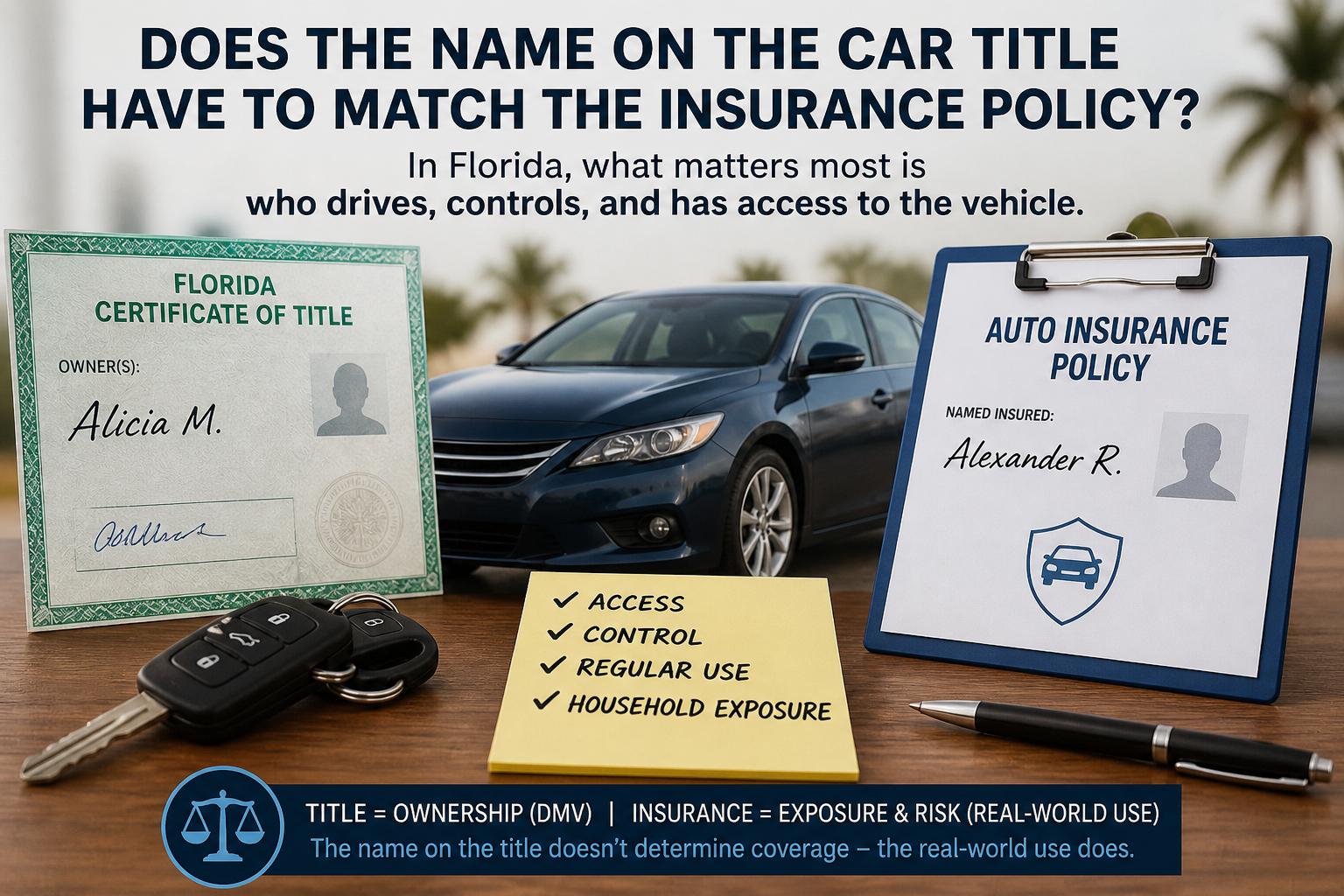
Quick answer: No — the name on the vehicle title does not require the insurance policy to be in the same name. What matters is who actually has access to and control of the vehicle — and how the policy is structured around that.
A Real Call I Got Today
I had this exact conversation today.
Alicia and Alexander called me.
They currently have a policy with State Farm — but things have changed. Alexander now needs an FR-44 filing.
The car is in Alicia’s name.
And the question came up right away:
“Wait… if the car is in her name, doesn’t the insurance have to be too?”
I hear this all the time — not just in this situation, but in a dozen different variations.
It sounds simple.
But the answer isn’t.
The Short Answer: No, It Doesn’t
There is no rule in Florida that says the insurance policy has be in the same name as the vehicle title.
You can have a car titled in one person’s name, an insurance policy in another person’s name, and both connected properly within the same policy. That setup is actually pretty common – I see it regularly.
The title is only one record involved in the arrangement. See Florida auto insurance laws and requirements explained to understand the separate roles of state law, the policy contract, underwriting, and financing.
What Insurance Companies Actually Care About
This is where a lot explanations online fall short.
Insurance companies aren’t really focused on the title. They’re focused on care, custody, and control – who has access to the vehicle, who regularly drives it, where it’s kept, and who effectively controls it day to day. That’s what they’re actually insuring.
The Household Reality Most People Overlook
If someone lives in the household, there is usually an assumption of access, even if “It’s not their car,” or “they don’t really drive it,” or the title is in someone else’s name entirely.
If the vehicle is sitting at the home, available and accessible, that exposure exists from an underwriting standpoint. That’s why insurance companies want household drivers disclosed and regular drivers rated properly. Nobody wants surprises at claim time.
Access Matters More Than Ownership
A title tells you who legally owns the car. Insurance looks at something broader: who has care, custody, control, access, and regular use of the vehicle? That’s the real test.
The distinction becomes even more important when insuring a vehicle owned by a trust because the titled owner and regular driver may not be the same legal person.
If someone in the household has regular access,
the insurance company may treat that as part of the overall risk —
even if their name isn’t on the title. That’s why moving names around doesn’t necessarily change the outcome. You’re not moving the risk. You’re just moving the paperwork.
Why FR-44 Situations Complicate This
When someone in the household has an FR-44 requirement liability limits go up, premiums go up, and understandably people start looking for ways to separate things.
But here’s the reality: even if you change names on the policy, you don’t remove care, custody, and control. If the driver still has access, the exposure is still there. I get into this in more detail in FR-44 Be a Driver, Not the Policyholder: It’s not about whose name is on the policy — it’s about who actually drives and controls the risk.
The Premium Angle (What People Try to Do)
Sometimes the goal isn’t structure at all — it’s price.
One driver may have stronger insurance credit, a better prior insurance history, or a cleaner driving record and the thought becomes, “What if we put the policy in their name instead?” Sometimes that can help — if done correctly.
But here’s what people miss: once drivers are properly accounted for, the premium impact often spreads across the household anyway. I break that down further in “Should My Teen Have Their Own Car Insurance Policy?” Once exposure exists, insurance companies price for it — regardless of whose name is on the title.
The Bank, Dealer, and Registration Side
This doesn’t only come up with insurance. I’ve seen it many times with financing and registration too.
A lienholder may want the vehicle owner tied to the policy, and If they’re not the named insured, lenders often want them listed anyway. At registration, it can raise questions if the owner isn’t connected to the policy. It doesn’t always stop things from moving forward, but it can create delays or extra requirements. along the way.
Real-World Example (What Usually Goes Wrong)
Here’s what I see most often: the car is in one person’s name, another person is the primary driver, and the policy is adjusted to try to lower the premium.
If that driver isn’t properly listed, claims can be adjusted, payments can be reduced, or coverage can be denied. That’s not rare – that’s how underwriting works.
Title vs. Policy — Two Different Systems
It helps to think of it this way: the title is legal ownership, tracked by the DMV. Insurance is exposure and risk, tracked by real-world use. they overlap, but they’re not the same thing.
Where People Try to “Game” It (And It Backfires)
This is where I step in most often. People try splitting names, moving policies around, or leave drivers off, all to lower the premium.
But you can’t paperwork your way out of exposure. If someone has access to the vehicle, the risk is still there, no matter whose name is on the policy.
The Smarter Question to Ask
Instead of asking, “Does the insurance have to be in the same name?” ask this instead: “What’s the smartest way to set this up so I’m protected — and still paying a competitive rate?”
Why Structure Matters More Than Names
This ties directly into something I talk about often: auto insurance isn’t just a policy — it’s a process.
The drivers, the vehicles, and the household exposure all determine whether a policy actually works the it’s supposed to.
The Bottom Line
No, the insurance does not have to be in the same name as the car. But it does have to reflect who has access, who drives, who controls the vehicle, and how it’s actually used.
Get that right, and everything works the way it should. Get it wrong, and it tends to show up when it matters most.
The same misunderstanding explains why every driver’s name may not appear on the insurance card even when the policy handles the driver correctly.
Related Florida Auto Insurance Guides
Whether you’re buying a new policy, comparing quotes, understanding Florida insurance laws, or looking for ways to lower your premium, these in-depth guides will help you make more informed insurance decisions.
• Florida Auto Insurance – Start with our complete guide to buying, comparing, and understanding Florida auto insurance from the ground up.
• Florida Auto Insurance Coverage and Claims – Learn how liability, collision, comprehensive, uninsured motorist coverage, and the claims process work before you ever need them.
• Florida Auto Insurance Laws and Requirements – Understand Florida’s insurance laws, minimum coverage requirements, FR-44 and SR-22 filings, and the legal responsibilities every Florida driver should know.
• Safe Driving & Saving Money – Discover the many factors that influence your premium, practical ways to reduce your insurance costs, and how smart driving habits can help you save over time.
• Florida FR-44 Insurance – Everything Florida drivers need to know about FR-44 insurance after a DUI, including filing requirements, reinstatement, non-owner policies, and affordable coverage options.
Continue Learning About Florida Auto Insurance Laws
Florida’s insurance laws can be confusing, especially when different situations require different rules. The articles below explain many of the legal questions Florida drivers ask most often and provide more detailed guidance on each topic.
Florida Auto Insurance Laws and Requirements: What Drivers Actually Need to Know
Florida auto insurance rules don’t come from one place. They come from state law, your policy contract, your carrier’s underwriting rules, and sometimes your lender
The Car Is in My Name—Doesn’t the Insurance Have to Be Too? (This article)
Vehicle ownership and insurance don’t always have to match exactly. This article explains when the owner, the policyholder, and the primary driver may legally be different people.
The Car Is Owned by a Trust—Who Needs the Insurance?
Trust-owned vehicles often create confusion about who should purchase the insurance policy. Learn how insurance typically works when a vehicle is titled in the name of a trust.
Why Your Car Insurance Goes Up When Your Teen Gets a License
Many parents are surprised when premiums increase dramatically after a learner becomes a licensed driver. Learn why this happens and what factors affect the cost.
When Medical Advice Affects Your Ability to Drive, What Florida Auto Insurance Actually Requires
A doctor’s advice not to drive doesn’t cancel your Florida policy — but ignoring how it connects to your license status and coverage can cause problems.
Florida now offers driver’s license knowledge tests in English only. Learn what changed and what new drivers should know before taking the exam.
Florida Operation Green Light (Archived)
Florida’s Operation Green Light events can help eligible drivers resolve outstanding court obligations and restore driving privileges. This article explains how the program works and who may qualify.
About the Author
Written by Clifford Schimek — Florida Auto & FR-44 Insurance Expert
I help Florida drivers every day with auto insurance quotes and FR-44 filings. My goal is to make everything simpler and less stressful, no matter where you live in the state. I deal with situations like this every day — where ownership, drivers, and insurance requirements don’t line up neatly. That’s where experience matters. If something feels off about how your policy is set up, there’s usually a reason — and I’m always happy to take a look.
Clifford Schimek — Florida Auto & FR-44 Insurance Expert
Call or text: 305-796-2968
Learn More About Cliff
Why Clifford Schimek? – The case for working with me
Florida Auto Plus Insurance – Agency website
Florida FR-44 Information and Guidance – For Florida drivers who need an FR-44 filing
View my Google Business Profile – Reviews and Business information