
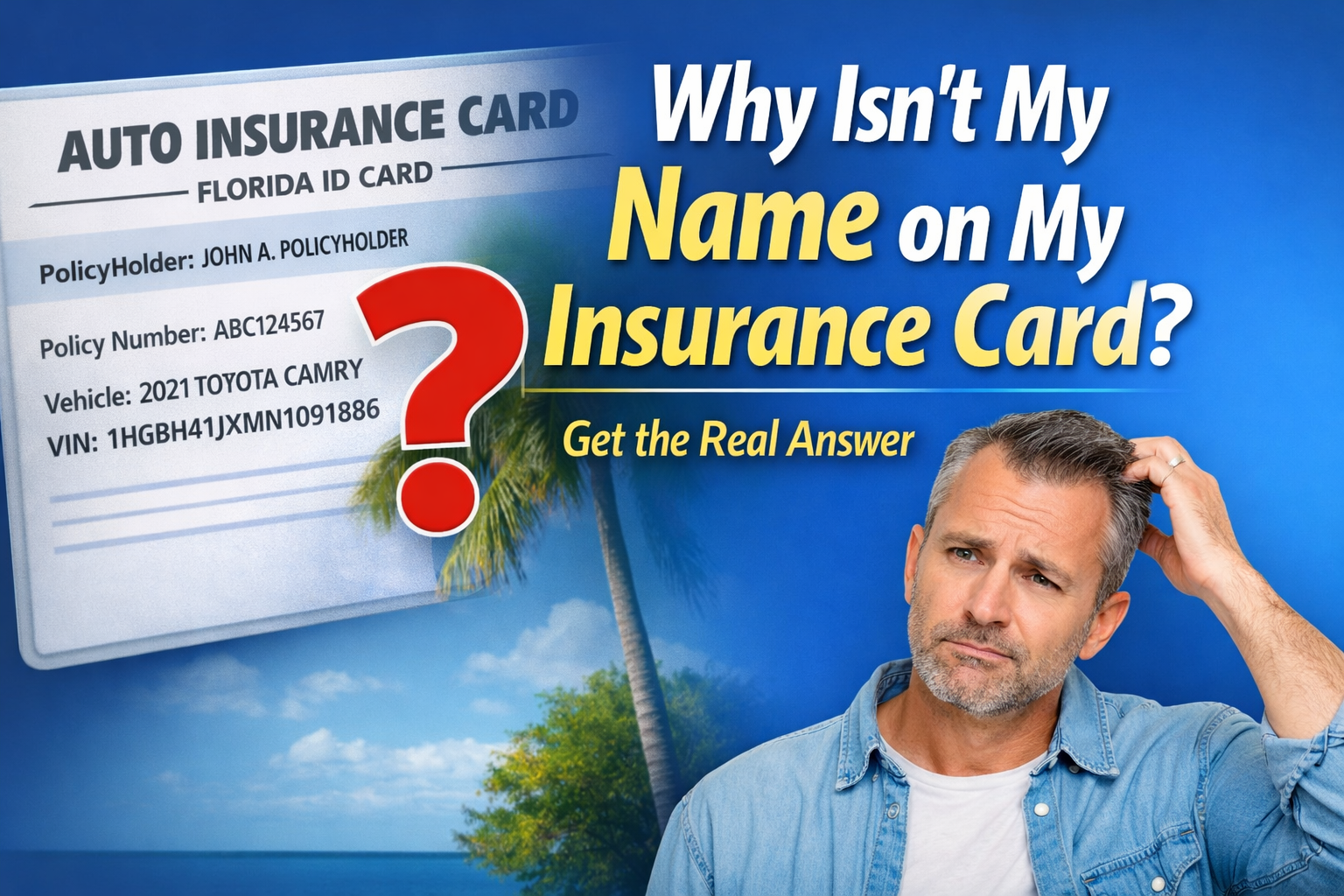
Quick answer: If your name isn’t on the insurance ID card, that’s usually normal — most companies only print the policyholder’s name, since the card’s job is to prove the vehicle is insured, not to list every driver. Your full list of covered drivers shows up on the policy’s Declarations Page instead.
This is a question I hear all the time.
A driver looks at the insurance ID card and says:
“I’m listed as a driver on the policy… so why isn’t my name on the card?”
Many Florida drivers search for this exact question: “Why isn’t my name on my insurance card?” The answer is simpler than most people expect.
If your name isn’t on the car insurance ID card, that’s usually normal. Most insurance companies print only the policyholder’s name on the card, not every listed driver. The ID card’s main purpose is simply to confirm that the vehicle itself is insured.
It’s a fair question, but the answer surprises many people.
The short version is simple:
Insurance ID cards usually show the policyholder — not every driver on the policy.
And that’s completely normal.
That does not necessarily mean the policyholder’s name must match the name on the vehicle title in every situation. I explain that distinction in The Car Is in My Name—Doesn’t the Insurance Have to Be Too?
What the Insurance ID Card Is Actually Proving
When law enforcement, a dealership, or another party asks for proof of insurance, the ID card isn’t verifying who is driving the vehicle.
Instead, it’s verifying something much more important:
That the vehicle itself is insured.
The key information on the insurance ID card typically includes:
- Policy number
- Insurance company
- Effective dates of coverage
- Year, make, and model of the vehicle
- Vehicle Identification Number (VIN)
- The named policyholder
Those vehicle details — especially the VIN number — are the critical piece. They confirm that a specific car has active insurance coverage.
That’s what proof of insurance is designed to establish.
The insurance card is only one part of Florida’s larger proof-of-insurance and policy-compliance system. For a broader explanation, see Florida auto insurance laws and requirements and how the insurance card, declarations page, vehicle registration, drivers, and policy contract fit together.
Why Every Driver Doesn’t Appear on the ID Card
Auto insurance policies can include multiple drivers, such as:
- Spouses
- Teen drivers
- Adult children
- Other household members
- Additional listed drivers
And sometimes the person driving the car may not even be a listed driver at all.
For example, maybe a neighbor borrows your car because theirs is in the shop and they need to run an errand. If you gave them permission to use your vehicle, your policy may still provide coverage for that situation. That is often referred to as permissive use.
A permissive-use driver would not appear on the insurance ID card — which is another reason the card focuses on the vehicle and policyholder, not every possible person who might drive it.
In many households, there could easily be three, four, or more drivers connected to a single policy.
But insurance ID cards are not designed to list everyone.
Instead, they display the named policyholder — the person who owns or controls the policy contract.
That person is responsible for things like:
- Making payments
- Making coverage decisions
- Authorizing changes
- Receiving official policy correspondence
- Handling claim communications
In other words, the policyholder is the person legally tied to the insurance contract, which is why their name appears on the ID card.
Parents are often especially concerned when a teenager’s name does not appear on the card. But being listed as a driver is different from being the policyholder, and in most cases, putting a teen on their own car insurance policy is not the least expensive or simplest solution.
The more important moment to watch is when a permit holder becomes fully licensed, because that change can cause the young driver to become fully rated on the policy. Here is why car insurance goes up when a teen gets a license.
This becomes particularly important when an adult child leaves home for school. The student’s name may not appear on the insurance card, but the policy still needs to show the correct driver, garaging address, vehicle location, and household arrangement. See how to structure Florida car insurance for a college student without creating an address or coverage problem.
What I Send Clients When This Question Comes Up
When one of my clients asks this question, I usually send them another document from their policy that clears everything up immediately.
It’s called the Declarations Page, often referred to as the “Dec page.”
This document lists the full structure of the policy, including:
- The policyholder
- All listed drivers
- Household residents
- Any excluded drivers
- The vehicles covered
- The coverage limits
So if a driver wants confirmation that they are properly listed on the policy, the declarations page is where you’ll see it clearly.
That document shows exactly who is included on the policy and how the insurance company recognizes each person in the household.
It’s a little like the confusion I see around the term “full coverage” — people assume a phrase or a card tells the whole story, when the real answer is usually sitting in a different document entirely. I get into that pattern in Full Coverage Isn’t a Real Policy — Here’s What You Actually Have.
This is also a good example of something I explain to clients frequently:
Auto insurance isn’t really a “set it and forget it” product — it’s an ongoing process.
Drivers need to pay attention to policy updates, correspondence from the insurance company, and changes that affect the household.
I get into that idea in more detail in Auto Insurance Isn’t Just a Policy — It’s a Process, if you’d like to see how it applies beyond just this one question.
Many drivers find that article helpful because auto insurance really isn’t something you set once and forget. It’s an ongoing process that changes as drivers, vehicles, and household situations evolve.
Remember: Insurance Typically Follows the Car
Another reason driver names aren’t listed is because, in many situations:
Auto insurance follows the vehicle — not the driver.
That means if you allow someone to drive your car with your permission, your policy may provide coverage for that situation.
For example, the driver could be:
- A family member
- A friend
- A neighbor
- Someone helping you move the car
As long as the vehicle is insured and the use is permitted, coverage generally follows the car.
Situations where the structure of the policy becomes especially important are cases involving FR-44 insurance filings, where the drivers listed on the policy and the coverage limits must meet strict legal requirements. I walk through how that works in FR-44 Insurance Is Not a Policy — It’s an Ongoing Compliance Requirement.
Florida Drivers Ask This Question Everywhere
I hear this question from drivers all across the state.
Whether someone calls from Tampa Bay, Orlando, Jacksonville, Miami, or anywhere else in Florida, the misunderstanding is usually the same — people assume the insurance ID card should list every driver.
But once you understand that the card is really confirming that the vehicle itself is insured, the structure makes much more sense.
The structure can become even more complicated when a car is owned by a trust, because the titled owner, named insured, primary driver, and additional interest may all be different parties.
Digital Insurance Cards Work the Same Way
Today many drivers use digital insurance cards on their phones.
But the structure is exactly the same.
The card still shows:
- The policyholder
- The policy number
- The vehicle information
- The coverage dates
It still doesn’t list every driver on the policy.
Whether your card is paper or digital, it’s worth knowing when you might actually need to hand it over — and why I still tell clients to keep both versions on hand. I cover that in Why I Still Carry a Paper Insurance Card (Even Though It’s on My Phone).
The Bottom Line
If you’re a driver listed on a policy but your name isn’t on the insurance ID card, there’s usually nothing wrong at all.
The ID card isn’t meant to identify every possible driver.
Its job is simply to prove that the vehicle is insured and covered by an active policy.
And when someone wants to confirm exactly who is listed on the policy, the declarations page provides the full picture.
Related Florida Auto Insurance Guides
Whether you’re buying a new policy, comparing quotes, understanding Florida insurance laws, or looking for ways to lower your premium, these in-depth guides will help you make more informed insurance decisions.
• Florida Auto Insurance – Start with our complete guide to buying, comparing, and understanding Florida auto insurance from the ground up.
• Florida Auto Insurance Coverage and Claims – Learn how liability, collision, comprehensive, uninsured motorist coverage, and the claims process work before you ever need them.
• Florida Auto Insurance Laws and Requirements – Understand Florida’s insurance laws, minimum coverage requirements, FR-44 and SR-22 filings, and the legal responsibilities every Florida driver should know.
• Safe Driving & Saving Money – Discover the many factors that influence your premium, practical ways to reduce your insurance costs, and how smart driving habits can help you save over time.
• Florida FR-44 Insurance – Everything Florida drivers need to know about FR-44 insurance after a DUI, including filing requirements, reinstatement, non-owner policies, and affordable coverage options.
Continue Reading About Florida Auto Insurance
If you found this guide helpful, these articles explain some of the most common Florida auto insurance questions in greater detail:
- Auto Insurance Isn’t Just a Policy — It’s a Process – Start with our complete guide to buying, comparing, and understanding Florida auto insurance from the ground up.
- Why Specialization Matters — And Why Florida Drivers Get Better Results When They Work With a Specialist – Most agents juggle everything. I don’t.
- Don’t Assume Anything About Your Car Insurance – The costly assumptions that lead to coverage gaps and expensive surprises.
- Should My Teen Have Their Own Car Insurance Policy? – What Florida parents should know before making this important decision.
- Florida Car Insurance for College Students – How to insure students correctly while they’re away at school.
- Why Isn’t My Name on My Insurance Card?(this article) – One of the most misunderstood parts of Florida auto insurance.
- Auto Insurance in Jacksonville, Florida – Local considerations for Jacksonville-area drivers.
- Orlando Auto Insurance – Insurance issues unique to drivers in Central Florida.
- How Auto Insurance Really Works in the Tampa Bay Area – Regional considerations for Tampa Bay drivers.
- Progressive Just Made Signing Your Insurance Documents Faster, Easier, and Less Annoying (Archived) – This piece was written to announce Progressive’s Remote e-Sign rollout.
About the Author
Written by Clifford Schimek — Florida Auto & FR-44 Insurance Expert
I help Florida drivers every day with auto insurance quotes and FR-44 filings. Questions like “why isn’t my name on the ID card” come up constantly, and it’s usually nothing to worry about — just a case of knowing where to actually look. My goal is to make everything simpler and less stressful, no matter where you live in the state. If you ever need help or just want a straight answer, you can always call or text me directly.
Clifford Schimek — Florida Auto & FR-44 Insurance Expert
Call or text: 305-796-2968
Learn More About Cliff
Why Clifford Schimek? – The case for working with me
Florida Auto Plus Insurance – Agency website
Florida FR-44 Information and Guidance – For Florida drivers who need an FR-44 filing
View my Google Business Profile – Reviews and business