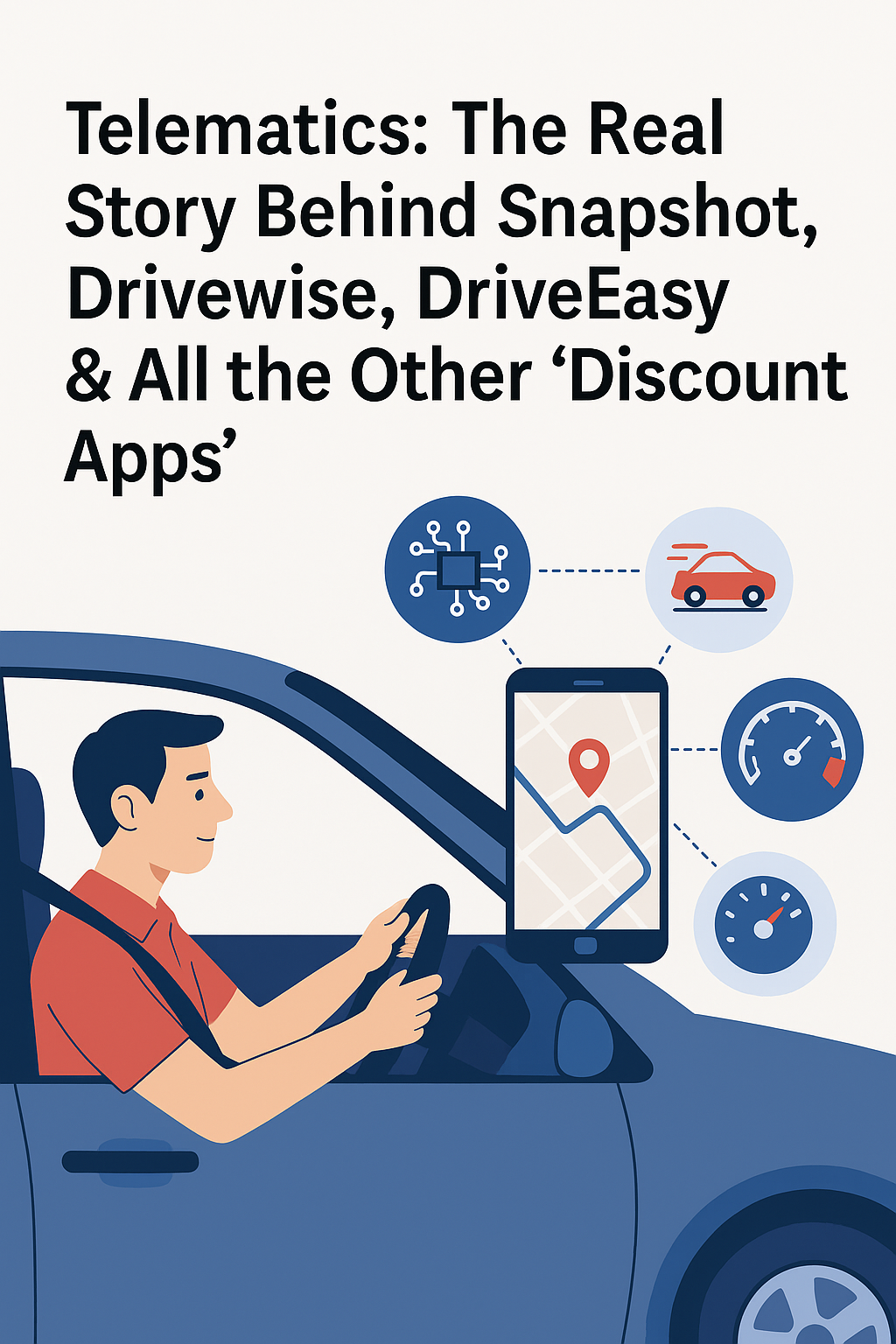
Quick answer: Every major carrier has its own telematics program promising big savings — Progressive’s Snapshot, Allstate’s Drivewise, GEICO’s DriveEasy, Liberty Mutual’s RightTrack, State Farm’s Drive Safe & Save. Behind the branding, they all work the same way: they watch how you drive, then use that data to set your price.
Telematics is only one piece of a much larger pricing puzzle. Our guide, The 15 Invisible Things Raising Your Florida Auto Insurance Rate (That No One Ever Explains), explains the many hidden factors that insurance companies consider when calculating your premium.
If you’ve shopped for Florida auto insurance lately, you’ve probably been pushed toward some “telematics program” promising big savings. Progressive calls it Snapshot. Allstate has Drivewise. GEICO pushes DriveEasy. Liberty Mutual offers RightTrack. State Farm runs Drive Safe & Save.
Every company has its own branding, but behind the scenes, they all work the same way: they watch how you drive — and use that data to adjust your price.
Nobody really explains it. Most agents don’t want to upset people. Companies only talk about “savings.” But I work with Florida drivers every day — including high-risk and FR-44 clients — and I’ll tell you the real version.
What Does Telematics Actually Track?
Time of day. Night driving (11 p.m.–5 a.m.) is a big negative in Florida. It doesn’t matter if you’re sober, a nurse on night shift, or just heading home.
Hard braking and acceleration. If Miami traffic forces you to slam your brakes twenty times, the app doesn’t know why — it just logs the events.
Speed relative to the road. If the limit is 35 and you’re doing 50, it shows up in your data.
Phone movement. Most telematics programs detect phone pickups, swipes, taps, and movement.
Trip style. Short, choppy city trips make you look aggressive. Long, steady highway trips look safe.
Is the “Save Up to 30% or 40%” Promise Real?
Here’s the reality: “up to” means almost nobody gets the highest discount.
The unicorn driver doesn’t drive late, doesn’t tailgate, rarely touches their phone, drives mostly highway, and has monk-level patience. Most Florida drivers land much lower than that.
Also — many companies price your first policy assuming you’ll drive like a superstar, then correct it at renewal once your real data rolls in. That’s where the surprise rate jumps come from.
What Don’t They Tell You Up Front?
Passengers can hurt your score — if your friend is scrolling on their phone in the passenger seat, some apps assume it’s you. Rideshare drivers and late-night workers get penalized too, not intentionally, just statistically. City driving in Miami, Orlando, or Tampa always looks worse on paper, simply because there’s more braking and more events to log. Driving behavior isn’t the only thing insurers evaluate. Where you live also affects claim frequency, repair costs, theft rates, and litigation trends, which I explain in Why Your ZIP Code Can Affect Your Florida Auto Insurance Rate. And plenty of people start “driving for the app” — braking early, creeping through lights — just to avoid a ding on their score.
What About Telematics for FR-44 Drivers?
If you need a Florida FR-44 filing because of a DUI, you’re already under higher scrutiny. Telematics can help you or hurt you — there’s no middle ground.
My rule is simple: if your lifestyle or driving patterns match the things telematics punishes, don’t do it. Some agents won’t say that outright. I will.
Is There a Privacy Concern With Telematics?
People quietly ask me, “Cliff, can they see everywhere I go? Can this affect a claim?”
Companies say it’s for pricing, not claims — but once the data exists, it exists. If the idea of being monitored stresses you out, telematics will never feel good, discount or not.
What’s the Long-Term Trend Nobody Talks About?
Telematics isn’t going away. But here’s the real long-term truth: it’s splitting drivers into two separate risk pools, and those pools drift further apart every year.
The telematics group is constantly proving itself — less braking, fewer late-night miles, less phone use, smoother trips. The bad drivers weed themselves out over time, and this group gets rewarded for it; their rates trend downward or stay stable.
The non-telematics group isn’t made up of bad drivers — just unverified ones. But in insurance, more unknowns generally means more assumed risk, and more assumed risk means more cost. That gap grows every renewal cycle. Telematics drivers drift toward lower pricing, while the non-telematics pool loses out simply because they were never part of the verified-safe group.
Vehicle technology is changing insurance in more ways than one. The same sensors that help telematics programs evaluate driving also make modern vehicles much more expensive to repair after a crash. I explain why in Why Safer Cars Still Have Higher Collision Insurance Costs.
This is exactly where the industry is headed. Telematics isn’t just about one discount — it’s about which future pricing group you end up in.
Want Straight Advice on Whether Telematics Makes Sense for You?
If you want real advice based on your actual situation — not a corporate pitch — call or text me anytime.
Most of my clients find me online, check my reviews, and then call once they feel comfortable. If you’d like to do the same, you can see my Florida Auto Plus Insurance Google profile and read what real Florida drivers say about working with me. And if you’d rather skip all that and just talk, call or text 305-796-2968 anytime.
If you’ve shopped for Florida auto insurance lately, you’ve probably been pushed toward some “telematics program” promising big savings. Progressive calls it Snapshot. Allstate has Drivewise. GEICO pushes DriveEasy. Liberty Mutual offers RightTrack. State Farm runs Drive Safe & Save.
Every company has its own branding, but behind the scenes, they all work the same way: they watch how you drive — and use that data to adjust your price.
Nobody really explains it. Understanding telematics is part of understanding how today’s insurance market works. That’s why I tell Florida drivers that auto insurance isn’t just a policy—it’s a process, and why I put together my complete guide, Auto Insurance Isn’t Just a Policy—It’s a Process. Most agents don’t want to upset people. Companies only talk about “savings.” But I work with Florida drivers every day — including high-risk and FR-44 clients — and I’ll tell you the real version.
What Does Telematics Actually Track?
Time of day. Night driving (11 p.m.–5 a.m.) is a big negative in Florida. It doesn’t matter if you’re sober, a nurse on night shift, or just heading home.
Hard braking and acceleration. If Miami traffic forces you to slam your brakes twenty times, the app doesn’t know why — it just logs the events.
Speed relative to the road. If the limit is 35 and you’re doing 50, it shows up in your data.
Phone movement. Most telematics programs detect phone pickups, swipes, taps, and movement.
Trip style. Short, choppy city trips make you look aggressive. Long, steady highway trips look safe.
Is the “Save Up to 30% or 40%” Promise Real?
Here’s the reality: “up to” means almost nobody gets the highest discount.
The unicorn driver doesn’t drive late, doesn’t tailgate, rarely touches their phone, drives mostly highway, and has monk-level patience. Most Florida drivers land much lower than that.
Also — many companies price your first policy assuming you’ll drive like a superstar, then correct it at renewal once your real data rolls in. That’s where the surprise rate jumps come from.
That’s one reason timing matters when comparing companies. Shopping before a renewal rather than reacting afterward can make a meaningful difference, as I explain in Florida Auto Insurance Quotes: Why Timing Matters as Much as Price.
What Don’t They Tell You Up Front?
Passengers can hurt your score — if your friend is scrolling on their phone in the passenger seat, some apps assume it’s you. Rideshare drivers and late-night workers get penalized too, not intentionally, just statistically. City driving in Miami, Orlando, or Tampa always looks worse on paper, simply because there’s more braking and more events to log. And plenty of people start “driving for the app” — braking early, creeping through lights — just to avoid a ding on their score.
What About Telematics for FR-44 Drivers?
If you need a Florida FR-44 filing because of a DUI, you’re already under higher scrutiny. Telematics can help you or hurt you — there’s no middle ground.
My rule is simple: if your lifestyle or driving patterns match the things telematics punishes, don’t do it. Some agents won’t say that outright. I will.
Is There a Privacy Concern With Telematics?
People quietly ask me, “Cliff, can they see everywhere I go? Can this affect a claim?”
Companies say it’s for pricing, not claims — but once the data exists, it exists. If the idea of being monitored stresses you out, telematics will never feel good, discount or not.
What’s the Long-Term Trend Nobody Talks About?
Telematics isn’t going away. But here’s the real long-term truth: it’s splitting drivers into two separate risk pools, and those pools drift further apart every year.
The telematics group is constantly proving itself — less braking, fewer late-night miles, less phone use, smoother trips. The bad drivers weed themselves out over time, and this group gets rewarded for it; their rates trend downward or stay stable.
The non-telematics group isn’t made up of bad drivers — just unverified ones. But in insurance, more unknowns generally means more assumed risk, and more assumed risk means more cost. That gap grows every renewal cycle. Telematics drivers drift toward lower pricing, while the non-telematics pool loses out simply because they were never part of the verified-safe group.
This is exactly where the industry is headed. Telematics isn’t just about one discount — it’s about which future pricing group you end up in.
Want Straight Advice on Whether Telematics Makes Sense for You?
If you want real advice based on your actual situation — not a corporate pitch — call or text me anytime.
Most of my clients find me online, check my reviews, and then call once they feel comfortable. If you’d like to do the same, you can see my Florida Auto Plus Insurance Google profile and read what real Florida drivers say about working with me. And if you’d rather skip all that and just talk, call or text 305-796-2968 anytime.
Related Florida Auto Insurance Guides
Whether you’re buying a new policy, comparing quotes, understanding Florida insurance laws, or looking for ways to lower your premium, these in-depth guides will help you make more informed insurance decisions.
• Florida Auto Insurance – Start with our complete guide to buying, comparing, and understanding Florida auto insurance from the ground up.
• Florida Auto Insurance Coverage and Claims – Learn how liability, collision, comprehensive, uninsured motorist coverage, and the claims process work before you ever need them.
• Florida Auto Insurance Laws and Requirements – Understand Florida’s insurance laws, minimum coverage requirements, FR-44 and SR-22 filings, and the legal responsibilities every Florida driver should know.
• Safe Driving & Saving Money – Discover the many factors that influence your premium, practical ways to reduce your insurance costs, and how smart driving habits can help you save over time.
• Florida FR-44 Insurance – Everything Florida drivers need to know about FR-44 insurance after a DUI, including filing requirements, reinstatement, non-owner policies, and affordable coverage options.
Continue Reading About Safe Driving & Saving Money
- The 15 Invisible Things Raising Your Florida Auto Insurance Rate (That No One Ever Explains) – Start with our complete Safe Driving & Saving Money guide to learn about the hidden factors that influence your Florida auto insurance premium and the practical steps you can take to keep your costs down.
- Florida Auto Insurance Quotes: Why Timing Matters as Much as Price — Learn why the day you shop for insurance can influence both your options and your premium.
- The Reports Behind Every Florida Auto Insurance Quote — Discover the reports insurance companies review before calculating your rate.
- Why Your ZIP Code Can Raise (or Lower) Your Florida Car Insurance — See how location affects premiums, even for drivers with identical records.
- What Snapshot, Drivewise, and Every Other Telematics App Really Do to Your Rate (current article) — Understand how driving-monitoring programs can lower—or sometimes increase—your insurance costs.
- Your Car Might Be Talking to Your Insurance Company — Learn how connected vehicle technology is changing the way insurers collect driving data.
- Cars Are Safer Than Ever… So Why Has Collision Coverage Never Been More Expensive? — Find out why advanced safety technology has also made many repairs significantly more expensive.
- Florida Auto Insurance Rates Are Finally Dropping in 2026 — Here’s What Changed — A closer look at the market conditions that led to declining premiums.
- Florida Auto Insurance: Rate Cuts and Refunds in 2026 (Archived) — Historical reference documenting insurer refunds and temporary rate reductions.
- Progressive Florida Rebate 2026 (Archived) — Background on Progressive’s rebate program and its place in recent market history.
- Progressive Florida Rebate Credit (Archived) — Learn why Progressive issued rebate credits, who qualified, and what those refunds meant for Florida policyholders during that unique period.
About the Author
Written by Clifford Schimek — Florida Auto & FR-44 Insurance Expert
I help Florida drivers every day with auto insurance quotes, liability protection decisions, and FR-44 filings. My goal is to make everything simpler and less stressful while helping drivers understand what they’re actually buying — not just what’s cheapest on paper. Because behind every telematics program’s branding, you deserve to know what’s actually being tracked and how it affects your price.
Clifford Schimek — Florida Auto & FR-44 Insurance Expert
Call or text: 305-796-2968
Learn More About Cliff
Why Clifford Schimek? — the case for working with me
Florida Auto Plus Insurance — agency website
Florida FR-44 Information and Guidance — for Florida drivers who need an FR-44 filing
View my Google Business Profile — reviews and business information